My, what a difference a year can make.
In February 2025, I wrote a post asking whether ChatGPT and Gemini use software review sites like G2. My conclusion: not directly. ChatGPT told me it didn’t crawl G2, TrustRadius or Gartner Peer Insights, and in my tests it answered from what it had been trained on, without searching the web. (Its web search had launched only months earlier and opened to signed-out users that same month, per Search Engine Land.) That’s no longer how it works. AI answers now often search the live web while the buyer waits, and the pages they find are mostly pages vendors don’t control.
When B2B buyers ask ChatGPT, Perplexity or Google’s AI which software to shortlist, the answer is built mostly from pages other people wrote: review sites, “best of” lists, comparisons and directories. In one study of 21,311 brand mentions in AI answers, 85% came from third-party sites and 13% from the brands’ own sites. So if you want AI to recommend you, the pages that matter most are often ones you don’t own. Your website still matters, mostly after the shortlist is made.
Key points:
- AI is where the shortlist starts. 94% of B2B buyers now use AI in the buying process (Forrester), and half of software buyers start their research in an AI chatbot more often than in Google (G2).
- The answers come from other people’s pages. Company websites earned 18.7% of 9.5 million AI citations in a 2026 Meltwater study. User-generated platforms and review sites earned 62.5% between them.
- Ranking on Google isn’t enough. Only 12% of the links ChatGPT, Gemini and Copilot cite rank in Google’s top 10 for the same question (Ahrefs).
- Reviews may move fast. In G2’s own data, AI citations rose within a median of four days of a burst of new G2
reviews . Kevin Indig, who ran the analysis, calls it “directional, not causal” (G2). - Measurement is the weak spot, and that’s also the opening for marketers who move early.
A post arguing for third-party content looks self-serving on a site that is itself a third-party content site. So this one leans on other people’s data, plus a few AI-citation checks of my own, and where a source has a stake in its finding, I say so.
Table of contents
- Do AI answers cite third-party pages more than vendor websites?
- How many B2B buyers use AI to build their shortlist?
- Does your own website still matter?
- What does this look like for a real B2B SaaS vendor?
- Which third-party pages do AI engines cite?
- Is AEO just SEO with a new name?
- How have I used third-party content as a vendor marketer?
- Should you pay to be included in third-party content?
- Who shouldn’t bother with AI visibility?
- How do you measure AI visibility?
- What should you do first?
- Get on the pages before your competitors do
Do AI answers cite third-party pages more than vendor websites?
Yes, by a wide margin, in every large study I found. The numbers vary with the engine, the questions and the method, but the direction doesn’t.
- AirOps, which sells software for managing off-site content, analyzed 21,311 brand mentions across ChatGPT, Claude and Perplexity on more than 500 commercial queries. “85% of brand mentions came from external domains,” and 13.2% from the brand’s own domain. “Nearly 90% of third-party mentions” came from listicles, comparisons or
reviews (AirOps, October 2025). - Meltwater analyzed 9.5 million AI citations across six AI platforms on B2B prompts, in a study co-published with LinkedIn (which comes out of it looking good). Meltwater also sells AI-visibility tracking. Company websites earned 18.7% of citations. User-generated platforms (LinkedIn, Reddit and YouTube) earned 47.5%, and peer review sites 15.0% (Meltwater, May 2026).
- Ahrefs, which sells SEO tools rather than off-site content, looked at 75,000 brands. The factor most closely tied to how often a brand appears in Google’s AI Overviews was how often other websites mention it (a correlation of 0.664), well ahead of backlinks (0.218). Ahrefs is careful to say “correlation ≠ causation” (Ahrefs, May 2025).
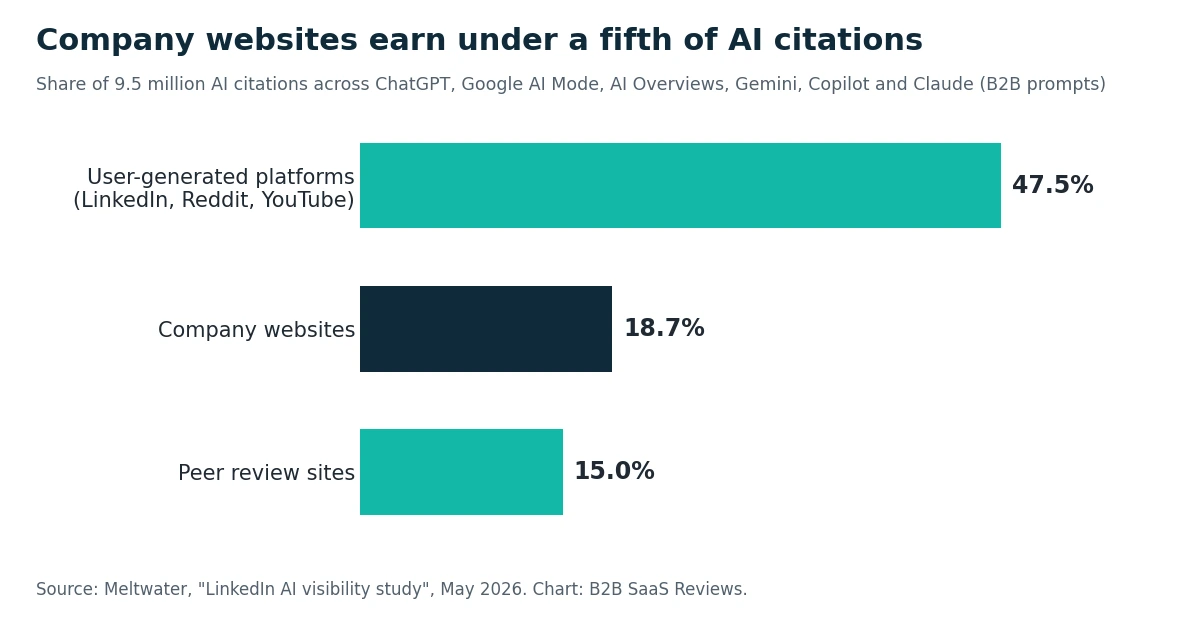
Source: Meltwater, May 2026. Chart: B2B SaaS
My read: being talked about on other sites is the closest thing AI visibility has to a ranking factor, and it’s mostly built off your own site.
How many B2B buyers use AI to build their shortlist?
Most of them, and the number has jumped in a year. In my February 2025 post, I quoted Wynter’s 2025 survey of SaaS CMOs: 24% started their vendor search with AI tools. In Wynter’s January 2026 survey of 101 mid-market SaaS CMOs, 84% used AI for vendor discovery (Wynter, February 2026).
The bigger surveys point the same way:
| Finding | Source |
|---|---|
| 94% of business buyers use AI in the buying process, up from 89% a year earlier | Forrester, January 2026 |
| 51% of B2B software buyers start their research with an AI chatbot more often than with Google (29% in 2025) | G2, The Answer Economy, March 2026 survey of 1,076 buyers |
| 69% chose a different vendor than they’d planned because of a chatbot’s recommendation, and one in three bought from a vendor they’d never heard of | Same G2 report |
G2, a review site with a stake in the answer, ran two surveys three months apart that disagree on what shapes the shortlist most: AI chatbots led in March (54% to 43%), review sites in June (38% to 37%). They’re neck and neck, and they feed each other: the chatbot builds the list partly from review sites.
AI’s influence also peaks at the stage vendors care about most. In G2’s June survey of 1,038 buyers, half of those who used AI chatbots said they had the most influence during evaluation (G2 2026 Buyer Behavior Report).
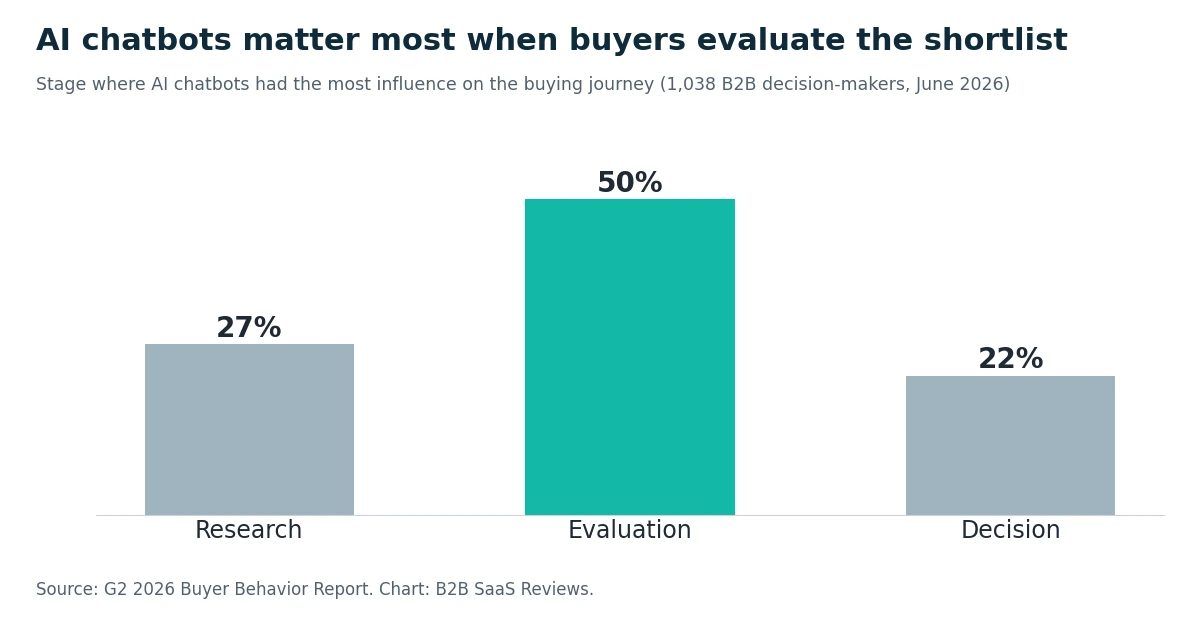
Source: G2 2026 Buyer Behavior Report. Chart: B2B SaaS
Does your own website still matter?
Yes. Third-party pages get you onto the shortlist, and your own site is where buyers check whether you belong there. This is the strongest counterpoint to everything above, and it’s fair to make it.
Wynter, which sells message testing and so has a stake in vendor websites mattering, asked 200 B2B software buyers who had used AI to research a vendor in the last 90 days what they did next. 72% went to vendor websites. Only 23% checked G2 or other review sites.
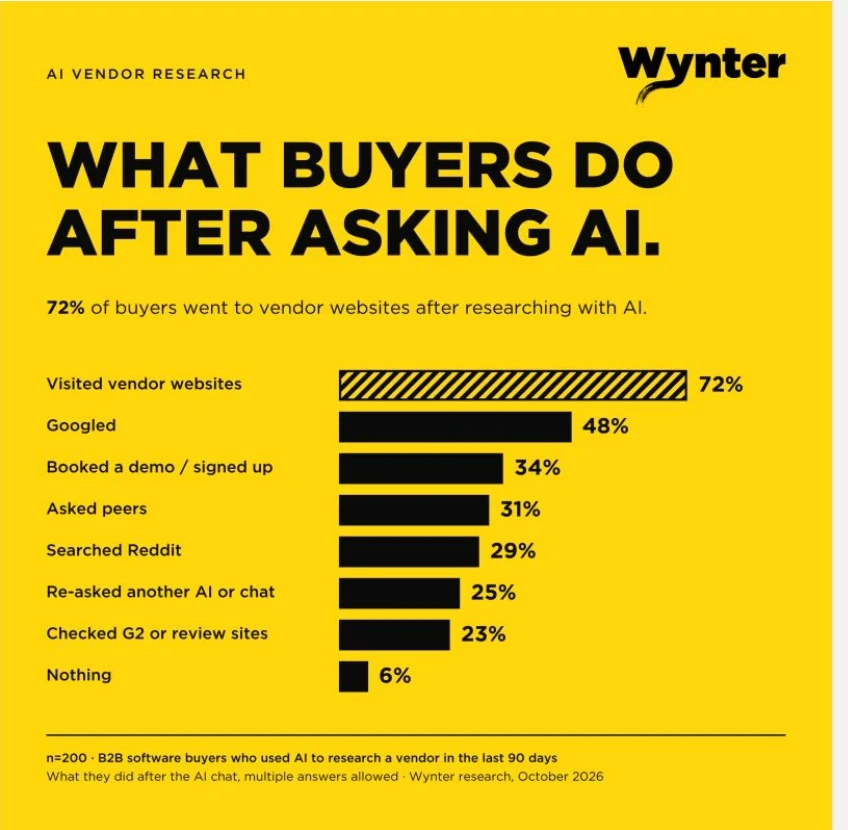
Source: Wynter research, October 2026, shared by Peep Laja on LinkedIn.
Peep Laja, Wynter’s CEO, summed it up: “So the AI builds the shortlist. Your website is where you get kept or cut.” I agree with both halves. The catch is the order. A buyer who starts with AI usually checks your website only after the AI has put you on the list, and the AI mostly builds that list from other people’s pages.
What does this look like for a real B2B SaaS vendor?
Here’s one I measured myself. On 13 November 2026, I asked Google’s AI Overviews and AI Mode five buyer questions about partnership and affiliate software, three times each: 30 answers in all. I used
What I found:
| What I measured | Result |
|---|---|
| PartnerStack recommended in unbranded “best” and “how to” questions | 17 of 18 answers |
| partnerstack.com cited as a source in those answers on AI Mode | 0 of 9 (and 5 of 9 on AI Overviews) |
| Pages that fed those AI Mode answers instead | An independent listicle (Hamster Garage), a listicle on another vendor’s blog (Siren) and a comparison page written by a direct competitor (FirstPromoter) |
| “PartnerStack | 4 of 6, citing a 1.7 rating from 62 |
So
The price. AI Mode said
The
Which third-party pages do AI engines cite?
Mostly pages that compare options with specifics: “best of” lists, head-to-head comparisons, review sites and community threads. Here’s what the engines took from each type in my
| Page type | Example from the run | What the engine quoted |
|---|---|---|
| “Best X” listicle | Hamster Garage, “Best Affiliate Software for SaaS” | A table: best for, entry price, built-in marketplace yes/no |
| Listicle on a vendor’s blog | Siren, “8 Best Partner Management Software for B2B SaaS” (dated four days before my run) | A “best for…” line per tool |
| Head-to-head comparison | Efficient App, “PartnerStack vs Impact” | One side-by-side table and a “choose X if…” verdict. It fed all three AI Mode answers to “PartnerStack vs impact.com” |
| Review site | G2, Trustpilot, Gartner Peer Insights | Rating, review count, pros and cons |
| Community | Reddit, YouTube | Opinions, including one outdated criticism |
Meltwater found the same on LinkedIn: of the most-cited LinkedIn content in its study, 54% were “best X” listicles and 50% side-by-side comparisons (a piece can be both), and content with “specific names, pricing data, and statistics” got quoted far more than generic thought leadership (LinkedIn on the Meltwater study, May 2026).
One warning about listicles: writing your own doesn’t get you the same result. Lily Ray tracked 100 B2B “best [category] software” questions in Google’s AI Overviews between April and June 2026. When a brand’s own “best” list was cited, the brand itself was left out of the recommendation “69% of the time” (224 of 323 cited listicles), often in favour of its competitors. For “best project management software”, Google cited self-promoting lists from Wrike, Paymo, Celoxis and Kanbanchi, then recommended Asana, monday.com, ClickUp and Notion (Lily Ray, June 2026).
A cited list still earns a link, but Pew Research found that Google users clicked a link inside an AI summary in about 1% of visits (Pew Research, July 2025). The recommendation is what the buyer reads. So the better bet is getting onto other people’s lists, and plenty of them. One list won’t make the web talk about you.
What happens in a category everyone knows?
PartnerStack’s category is a niche, so I also checked one that nearly every B2B SaaS company buys from and every vendor markets hard: project management software. On 19 November 2026, I asked four engines which project management software is best for a typical B2B SaaS company, once each. It’s a spot check, not a study. Still, they agreed on the shortlist (Asana, Jira, monday.com and ClickUp, with Linear and Notion at the edges), and on where to look:
| Engine | Top pick | Pages behind the answer |
|---|---|---|
| ChatGPT | Asana | “Best of” lists from TechnologyAdvice, TechRepublic and Forbes Advisor, plus G2 and Capterra. Asana’s own site only for its price |
| Google AI Overviews | No single pick: Jira, Asana, ClickUp, Airtable, monday.com and TMetric | Forbes Advisor and 20four7VA, plus Airtable’s own solutions page and a LinkedIn article that matches TMetric’s own blog listicle |
| Google AI Mode | Asana | “Best of” lists from PCMag, projectmanagertemplate.com and saascompared.io |
| Claude | Linear for engineering, Asana for everyone else | Zapier, TechRepublic and Product Hunt for the ranking, and vendor pricing pages for prices |
I ran Claude with web search in Claude Code, not the claude.ai app, so its setup differs from what most buyers see.
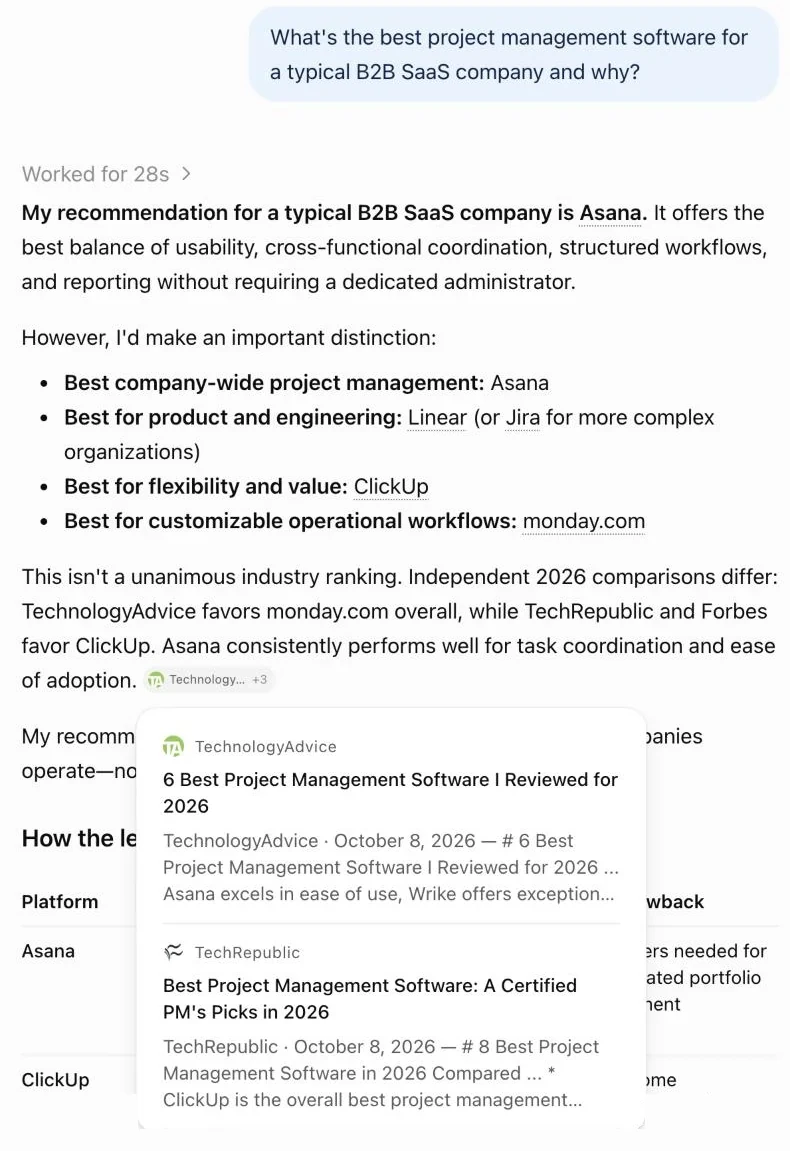
Source: ChatGPT, 19 November 2026. Screenshot: B2B SaaS
Asked again “based on credible, trusted sources, not vendor marketing”, ChatGPT kept Asana and dropped vendor pages altogether, while noting that its sources have commercial ties of their own (ChatGPT). So in this check, even in a crowded category with big marketing budgets, the shortlist came from a small set of third-party pages, and the vendors’ own feature pages barely showed up.
Vendors can still get in through a side door: their partners. When I searched “asana vs monday.com” the same day, the first source in Google’s AI Overview was a comparison by Till Freitag, a consultancy that sells monday.com setup and lists monday.com among its technology partners. Its verdict picks monday.com (Till Freitag, February 2026). To a reader, and probably to the engine, it’s a third-party page. If you have implementation or agency partners, their comparisons count too.
Reviews show up in AI answers fast
Of all the third-party content,
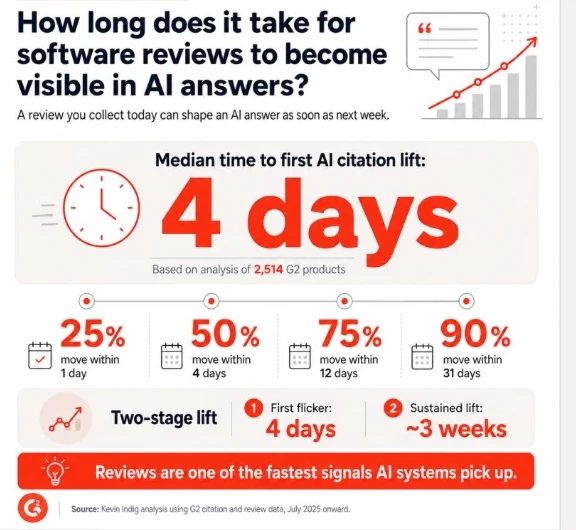
Source: Kevin Indig analysis using G2 citation and review data, July 2025 onward.
Indig works with G2, which sells review generation, and he calls the effect “directional, not causal.” It does fit what buyers say. In G2’s March survey, review-site citations were the top signal that made buyers trust an AI answer (G2).
For more on how review sites work for vendors, see why software reviews matter in B2B and my review of G2.
Is AEO just SEO with a new name?
No, but it isn’t a different discipline either. The loud versions, “AEO is just SEO” and “AEO changes everything”, do well on LinkedIn. The evidence is less exciting: a lot of overlap and some real differences. Here are the three strongest arguments on each side.
The case that AEO is SEO
- The engines are built on search. Google’s AI Overviews and AI Mode can use a “query fan-out” technique, running several related searches and citing what they find (Google Search Central). On ChatGPT, the prompts that send it to the web look like search queries: 8.7 words on average in early 2026, against 13.5 for prompts that didn’t (Semrush, April 2026; Semrush sells SEO tools).
- Google says so. Its documentation says “There are no additional requirements to appear in AI Overviews or AI Mode” (Google Search Central). Danny Sullivan of Google Search put it more bluntly in August 2025: “Good SEO is good GEO” (Search Engine Land, September 2025). Google has an interest in saying there’s nothing new to game, so weigh that.
- The signals and the results overlap. Branded search volume, which good SEO also builds, was more closely tied to AI Overview visibility than backlinks were (0.392 against 0.218, in the same 75,000-brand Ahrefs study). And across 3,119 search terms, brands cited in an AI Overview got “35% more organic clicks and 91% more paid clicks” than brands that weren’t. Seer adds that it “cannot definitively prove that citation causes higher CTRs” (Seer Interactive, November 2025).
The case that AEO is different
- Ranking carries over less and less. Only 12% of the links ChatGPT, Gemini and Copilot cite rank in Google’s top 10 for the same question (Ahrefs, August 2025). Even on Google, the share of AI Overview citations from top-10 pages fell from 76% in July 2025 (Ahrefs) to 38% in March 2026 (Ahrefs), though Ahrefs changed its method in between.
- The win is different. SEO wins a click. AEO wins a place in an answer that, going by Pew’s figure, most people never click past. And being cited as a source isn’t the same as being recommended.
- You can’t measure it the same way. SparkToro and Gumshoe.ai (which sells AI tracking) had 600 volunteers run 12 prompts through ChatGPT, Claude and Google’s AI, 2,961 times in all. The odds of getting the same list of brands twice were under 1 in 100, and of the same list in the same order, about 1 in 1,000 (SparkToro, January 2026). How often you appear across many runs is worth tracking. Your position isn’t.
Where my own experience fits
When I dug into LLM citations at Wisedocs, domain authority seemed to count for much less than I expected. In one case, the most-cited page came from a site with a domain authority of about 10. My read is that it won because it answered the question directly, in the structure the AI wanted. That’s one anecdote, but it fits the Ahrefs data above: what ranks on Google carries over to AI answers less and less.
In SEO, the Goliaths tend to win. Google’s guidance puts trust first (“Of these aspects, trust is most important”, Google Search Central), and big, established sites usually carry more of it, so a small site with a great page often loses to a big site with a good one. AI answers seem to weigh relevance more, which gives the Davids a better chance. In that Ahrefs study, more than 80% of the citations in ChatGPT, Gemini and Copilot came from pages that don’t rank for the target query at all (Ahrefs, August 2025). Big brands still win plenty: in Ahrefs’ 75,000-brand study, the quarter of brands with the most web mentions got more than 10 times the AI Overview mentions of the next quarter. So my claim is narrower. A small site with the right page can get cited, which happens less often in SEO.
So, same or different?
Both. The foundations are the same: answer the question clearly and earn mentions on sites your buyers trust. Three things change on top of them.
- Where the effort goes. Most of an AI answer comes from pages you don’t own, so more of your work goes into getting onto them.
- How wide the field is. In SEO, the top few results on page one take most of the prize. AI answers cite pages from well beyond the top 10, and a small site with the right page can make the cut. So don’t write off small third-party sites when you decide where to be listed, and don’t assume your own site is too small to be cited.
- What you measure. How often you’re in the answer, not your position.
Nobody can give you the exact recipe yet, me included. So the most useful thing you can do is test it yourself: ask the engines the buying questions your buyers would ask, see which pages they quote, and put your effort into those pages. Then check again every 90 days, because what works is still changing.
How have I used third-party content as a vendor marketer?
I’ve worked on this from the vendor side for years. Two examples:
- At
PartnerStack , we focused on the sites that ranked highly for our buyers’ search terms. Then we either generatedreviews on them or pitched them on creating content with us, so we’d show up, and show up well, wherever our buyers were looking. It was part of an inbound engine that brought in roughly half of the company’s new business. - At Wisedocs, where I was Director of Marketing and ran this work directly, the goal was to move into a new market. Wisedocs had grown up in medical record review, and we wanted insurance carriers to see it in a newer, broader category: claims document review and claims intelligence. So we put the Wisedocs 2.0 launch in front of carriers on about a dozen insurance media sites, including a six-month sponsored series on Claims Journal. We also started building the company’s Gartner Peer Insights profile in the Insurance Claims Management Systems market. Along the way, our Ahrefs Domain Rating rose from 33 to 51.
Both put us on pages our buyers were already reading.
Here’s what AI answers say about Wisedocs now. In November 2026, after I’d left, ChatGPT’s top pick for claims document review at an insurance carrier was Wisedocs. Its evidence for “demonstrated carrier use” was Wisedocs’ own site and an Insurance-Canada.ca article from the campaign: a Wisedocs announcement the site republished after we reached out and worked with them on a content partner package. ChatGPT labelled the carrier results it took from them “vendor-reported” (ChatGPT).
Asked for the best claims intelligence solution “based on credible, trusted sources, not on vendor marketing”, ChatGPT switched its top pick to Shift Technology, backed by analyst research from Celent and Aite-Novarica. Wisedocs was one of six, with Gartner Peer Insights as its only evidence, and ChatGPT judged a 5.0 rating from three ratings “insufficient to establish category leadership”.
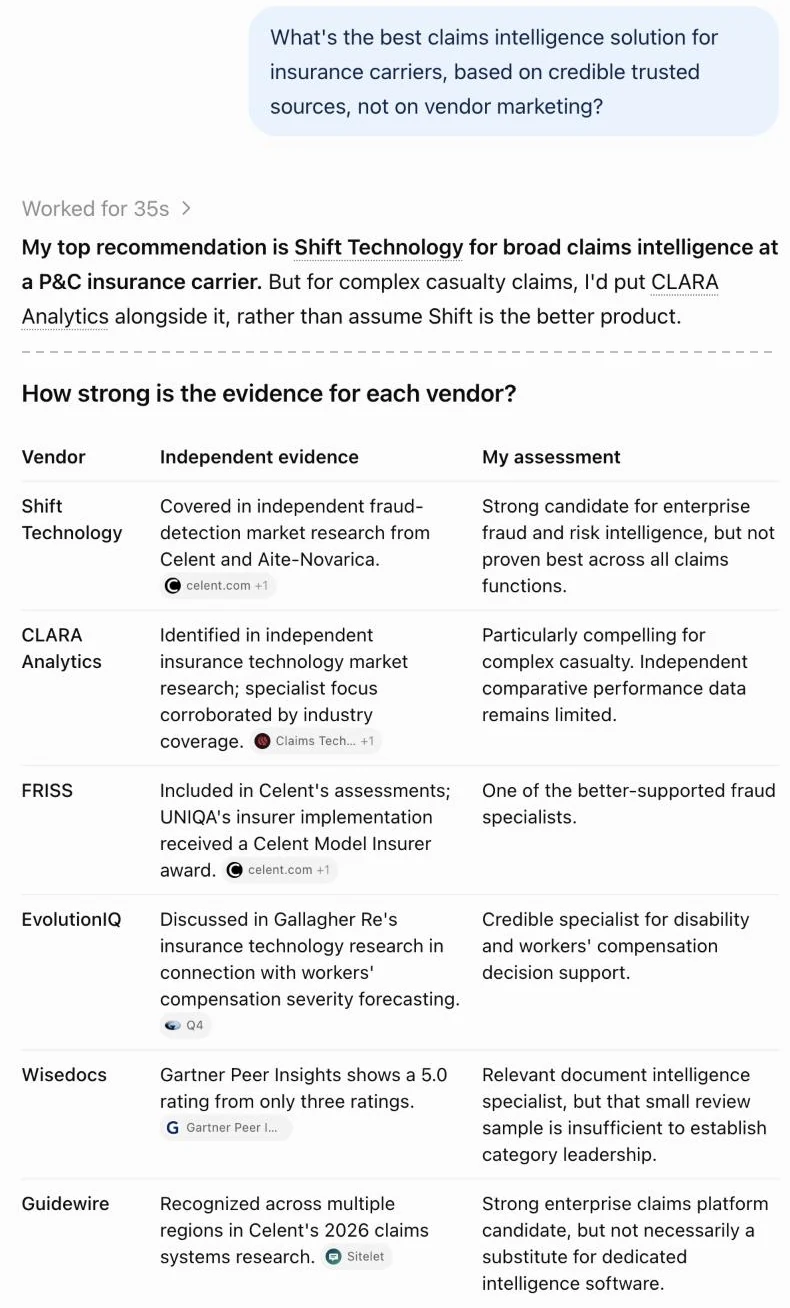
Source: ChatGPT, November 2026. Screenshot: B2B SaaS
That’s a handful of answers, not a study, but it shows the pattern from both sides. Other people’s pages played a significant part in putting Wisedocs into the carrier conversation: two of the three sources behind it were third-party sites (Insurance-Canada.ca and Gartner Peer Insights), even if one carried Wisedocs’ own announcement. And once the buyer asked for credible sources, three ratings weren’t enough to keep it on top.
Wisedocs’ own site did a lot of the work too, which fits a new category. Claims intelligence is young, Wisedocs closed its Series A in 2024 (Business Wire), and there aren’t many
Should you pay to be included in third-party content?
It’s a grey area, and most vendors end up doing a mix of earned and paid. If the placement is worth more than it costs, vendors pay for it. Plenty of buyers would call that pay-to-play, and they have a point.
Start with the kind AI engines read: paid partnerships inside editorial content, usually through affiliate links. “While we earn a commission from partner links, commissions do not affect our editors’ opinions or evaluations,” says Forbes Advisor. The “Featured Partners” links on its project management list (monday.com, ClickUp, Jira and Notion) are all affiliate links (Forbes Advisor, September 2026). On PCMag’s list, three of the six picks carry tracked links, and two of those look paid per click rather than per sale (PCMag, July 2026; links checked 19 November 2026).
That matters for AI. When I asked Google for the “best project management software compared” in November 2026, its AI Overview opened with Teamwork and Wrike, two of PCMag’s picks with tracked links, and cited PCMag first.
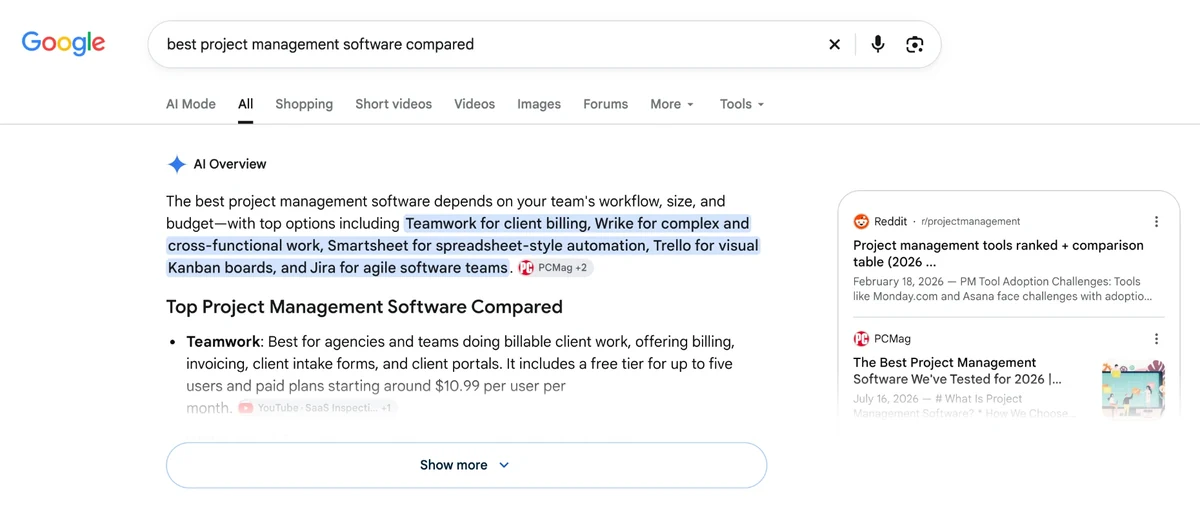
Source: Google AI Overview, November 2026. Screenshot: B2B SaaS
There’s no sign the links bought the answer: Smartsheet, third in that sentence, has no link on PCMag. But vendors that pay publishers per click or per sale help pay for the lists, and the lists are what AI engines read. You can work with publishers directly, or run an affiliate program on a network such as
Content partnerships work the same way. The Insurance-Canada.ca article ChatGPT cited for Wisedocs came from a content partner package we arranged, and ChatGPT still used it as evidence eight months later, though it labelled the results “vendor-reported”.
The most direct version now sits inside the answer itself. Google has sold ads in AI Overviews, labelled “Sponsored”, since October 2024 (Google, October 2024). When I searched “clickup alternatives” on 19 November 2026, the AI Overview listed its picks and then a sponsored suggestion to consider monday.com. So AI answers are going the way Google’s results went years ago: earned and paid side by side.
None of this is new in B2B software. Vendors have long paid for a better spot where buyers look: on Capterra, “the higher the bid, the higher up in the directory a vendor is displayed” (Capterra, 2015), and G2 now sells those spots as G2 Clicks (G2 documentation). Those ads buy a place on a directory’s category page. I’ve seen no sign they buy a place in AI answers.
If you pay, protect yourself and the buyer:
- Insist on a “Sponsored” label and
rel="sponsored"on paid links. - Don’t pay for followed links. Google treats paid followed links as link spam, and that risk lands on the publisher and on you.
- Pay real editorial sites, not “parasite” pages. Google’s site reputation abuse policy targets third-party content published to exploit a host site’s rankings.
- Don’t let the payment buy the verdict. Paid placement can buy inclusion and position. It shouldn’t buy the rating.
Disclosure: I sell labelled sponsored placements on this site, so I’m not neutral on this question. You can see the rules I work by on the for vendors page.
Who shouldn’t bother with AI visibility?
Vendors whose buyers aren’t using AI yet. If you sell to tech laggards who haven’t really adopted AI, the effort may not pay off. Meet those buyers where they are: at events, in direct messages, and with customer stories and the product features that matter to them.
For almost everyone else, it should be a priority. Forrester found that 94% of B2B buyers now use AI in the buying process (Forrester, January 2026), so the laggard segment is small and getting smaller.
Teams that can only fund what they can attribute. If every dollar has to show a cost per lead or cost per pipeline in your CRM, AI visibility is a hard sell today. You can see the work and the pipeline move together, but your CRM won’t credit AI with the deal. A “How did you hear about us?” field, where buyers name the source themselves, gets you closer (more on that below). Measurement alone shouldn’t stop you. But if direct attribution decides your budget, start small and set expectations early.
How do you measure AI visibility?
Not well yet, and that’s the biggest risk. Almost every B2B SaaS marketer I talk to knows they should be working on AEO. Very few know how to measure it. You can do a lot of work with little to show for it, or shape AI answers well enough to see pipeline rise without being able to tie it back.
A friend who markets at an enterprise software and hardware company told me their SEO team now tracks mentions and citations across 1,000 prompts against competitors. It’s loose: there’s no sentiment, so a negative mention counts the same as a positive one, and none of it ties to pipeline yet. The problem is big enough that a group has formed to try to set an AI search measurement standard.
Until one exists, here’s the method I use, and you can run it yourself for free:
- Pick 5 buyer questions: 3 about your category, “[your product]
reviews ” and “[your product] vs [your main competitor]”. - Ask each one 3 times per engine, because answers change from one ask to the next. Three is the minimum. Given how rarely SparkToro saw the same list twice, more asks give you a steadier number.
- For each answer, record three things: are you recommended, are you mentioned, and is your site cited?
- List the pages feeding each answer, and what the engine quotes from them.
- Check the answers for accuracy: prices, features, ratings.
- Re-run it every 90 days with the same questions.
Two cheap additions get you closer to pipeline. Track AI referrals in Google Analytics (visits from chatgpt.com, perplexity.ai and similar sources). And add an “AI assistant (ChatGPT, Perplexity, etc.)” option to the “How did you hear about us?” field on your demo form. Both undercount, because many buyers never click through, but they show the trend.
It won’t give you attribution. It will show you which third-party pages decide your story, and whether anything you change moves the answer.
What should you do first?
- Run the measurement above and save the answers. That’s your baseline.
- Fix wrong facts at the source. Publish prices, plans and key facts clearly on your own site. Then ask the third-party pages that got them wrong to update.
- Close your review gaps on the sites your answers actually cite, within each site’s rules. A thin profile gives the engines nothing to quote.
- Get onto the lists and comparisons that feed your category answers, by pitching them, through your partners or through clearly labelled sponsored placements. Skip the “best X” list with yourself at number one: in Lily Ray’s data, it more often helped your competitors.
- Give the engines something quotable: best-for lines, dated prices, comparison tables, named customers.
- Re-measure at 90 days, and keep what moved the answer.
Get on the pages before your competitors do
I’ve been in go-to-market and growth marketing for about 20 years. One lesson keeps repeating: what generates new business one year stops working the next. People love to buy but hate to be sold. Once a tactic is everywhere, buyers learn to spot it and put their guard up.
I’ve watched it happen with gated content: the marketing automation and form fills behind it worked wonderfully for years, until buyers learned a download meant a barrage of sales outreach. It arguably happened with automated outbound through tools like Outreach and Salesloft, and executive dinners may be next. The self-promotional listicle, a vendor’s own “best X” list with itself at number one, spread across B2B in 2025, until Google appears to have started discounting it in early 2026 (Lily Ray’s analysis; Google hasn’t confirmed a change). Some tactics fade because buyers tire of them. Others are loopholes the platform closes.
The vendors who win get there before the tactic is crowded and before buyers tune it out. Third-party content for AI visibility is at that early stage now. The lack of a standard way to measure it is its biggest weakness, and it’s also why there’s still room for the marketers willing to act before the numbers are tidy.
So here’s the question: when a buyer asks AI about your category tomorrow, whose pages will it quote, and will any of them say what you’d want them to?
Sources
- AirOps, The Influence of Offsite Signals in AI Search, 17 October 2025 (checked 2026-11-17)
- Ahrefs, Louise Linehan, An Analysis of AI Overview Brand Visibility Factors (75K Brands Studied), 26 May 2025 (checked 2026-11-17)
- Ahrefs, Louise Linehan, Only 12% of AI Cited URLs Rank in Google’s Top 10 for the Original Prompt, 11 August 2025 (checked 2026-11-17)
- Forrester, John Buten, B2B Buyers Make Zero-Click Number One, 22 January 2026 (checked 2026-11-17)
- G2, Tim Sanders, In the Answer Economy, Don’t Win the Click, Win the Answer, 15 April 2026, and the 2026 AI Search Insight Report (checked 2026-11-17/18)
- G2, 2026 Buyer Behavior Report, June 2026 survey (checked 2026-11-18)
- G2, Kevin Indig, How Long Does It Take for Software Reviews to Become Visible in AI Answers?, 10 June 2026 (checked 2026-11-18)
- Meltwater, Chris Hackney, LinkedIn AI visibility study, 12 May 2026 (checked 2026-11-18)
- Lily Ray, Why Calling Yourself the “Best” Could Be Helping Your Competitors Win in AI Search, 17 June 2026 (checked 2026-11-17)
- Pew Research Center, Google users are less likely to click on links when an AI summary appears in the results, 22 July 2025 (checked 2026-11-19)
- SparkToro, Rand Fishkin with Patrick O’Donnell (Gumshoe.ai), AIs are highly inconsistent when recommending brands or products, 28 January 2026 (checked 2026-11-19)
- Ahrefs, Louise Linehan, 76% of AI Overview Citations Pull From the Top 10, 21 July 2025, and Update: 38% of AI Overview Citations Pull From The Top 10, 2 March 2026 (checked 2026-11-19)
- Search Engine Land, Danny Goodwin, Google’s Danny Sullivan: ‘Good SEO is good GEO’, 2 September 2025 (checked 2026-11-19)
- Semrush, Luke Harsel, ChatGPT traffic analysis: Insights from 17 months of clickstream data, 7 April 2026 (checked 2026-11-19)
- Seer Interactive, Tracy McDonald, AIO Impact on Google CTR: September 2025 Update, 4 November 2025 (checked 2026-11-18)
- Wynter, How B2B SaaS CMOs Buy Software in 2026, 4 February 2026 (checked 2026-11-18); Wynter buyer research (n=200, October 2026) via Peep Laja on LinkedIn (chart from my screenshot of the post)
- Google Search Central: AI features and your website, Creating helpful, reliable, people-first content (checked 2026-11-18), site reputation abuse update (19 November 2024), link spam policy
- Search Engine Land, OpenAI drops sign-in requirement for ChatGPT search, 5 February 2025 (ChatGPT search timeline)
- Capterra, Caroline Malamut, What is PPC?, 9 April 2015 (checked 2026-11-19)
- Forbes Advisor, 10 Best Project Management Software of 2026, audited and verified 25 September 2026, and PCMag, The Best Project Management Software We’ve Tested for 2026, updated 16 July 2026 (both checked 2026-11-19, including every pick’s outbound link). Google AI Overview for “best project management software compared”: my screenshot, November 2026
- LinkedIn Marketing Blog, New Meltwater research shares 5 insights from 9 million citations, 21 May 2026 (checked 2026-11-19)
- Till Freitag, monday.com vs. Asana: Which Project Management Tool Fits Your Team?, 17 February 2026, updated 25 February 2026 (checked 2026-11-19; monday.com is listed under the site’s technology partners). It was the first AI Overview source for “asana vs monday.com” in my check on 19 November 2026
- Google, Shashi Thakur, New ways for marketers to reach customers with AI Overviews and Lens, 3 October 2024 (checked 2026-11-19). The sponsored monday.com block in the “clickup alternatives” AI Overview is from my check on 19 November 2026
- G2, G2 Clicks documentation (checked 2026-11-19)
- Vendr, PartnerStack pricing (median contract, checked November 2026);
PartnerStack , partner network; Trustpilot, Guidelines for Businesses - Insurance-Canada.ca, Wisedocs: Turning Claims Documents Into Decisions, 25 March 2026 (a Wisedocs release, republished through a content partner package)
- Business Wire, Wisedocs closes $12.7M Series A, 30 January 2024; PR Newswire, PartnerStack closes $29 million Series B, May 2021
- My own AI-citation checks:
PartnerStack (30 answers, Google AI Overviews and AI Mode, 13 November 2026); project management (ChatGPT, Google AI Overviews, Google AI Mode and Claude, 19 November 2026); Wisedocs carrier questions (ChatGPT, November 2026) - ChatGPT shared threads, read 2026-11-19 with every citation opened: project management, project management, credible sources, claims document review, claims intelligence, credible sources
Work with us
Want to get started with third-party content that shapes AI recommendations?
B2B SaaS