
Blastra is a done-for-you service that gets B2B software listed, accurate and monitored across G2, Capterra and about 30 other directories that buyers and AI assistants read. I tested its free account on
Key points:
- Free to start. Signup is two clicks with Google, and the free account includes a “Perceived Narrative Snapshot”, a 5-directory scan, the dashboard and the Blastra MCP.
- Strongest feature: the MCP. Connected to Claude, it turned a 5-directory scan into a prioritized gap list and a fit-rated list of free directories, three of them worth pursuing for
PartnerStack . - Biggest gap: it tells you what’s wrong (PartnerStack’s “fragmented” category story) but doesn’t always tell you what it recommends to change, and it doesn’t flag directories that look strong on paper but underdeliver.
- Pricing: paid plans start at $99 one-time for 3 listings, or $99 setup plus $59/month for ongoing monitoring (as of November 7, 2026).
- What I couldn’t test: the paid, done-for-you submissions. That needs a paid plan and a few weeks.
Table of contents
- What is Blastra?
- How I tested Blastra
- What is signup and onboarding like?
- What does Blastra’s Perceived Narrative Snapshot get right?
- Where does the snapshot fall short?
- What is the Blastra star, and can you trust it?
- What does the Blastra MCP add?
- What would Blastra have taken off my plate at PartnerStack?
- How much does Blastra cost, and is it worth it?
- What I couldn’t test
- Blastra FAQ
What is Blastra?
Blastra manages a software company’s listings on the directories and review sites that buyers and AI assistants read: G2, Capterra, Gartner Peer Insights, TrustRadius, SourceForge, Trustpilot and others. It scans where you’re listed, flags what’s missing or out of date, and its team submits and updates the listings for you. Its tagline is “One place to manage every listing AI and software buyers see.”
The directory list in my account covered 33 directories and launch platforms, from G2 and Capterra to niche sites for cybersecurity and web hosting. Blastra’s own pricing page promises a “full presence scan across 20+ directories” with every purchase.
It’s a mix of software and service. You onboard yourself and track progress in a dashboard, and Blastra’s team handles the submissions. For the full feature list, pricing and a summary of its G2
How I tested Blastra
I signed up for a free account on November 7, 2026. I started with b2bsaasreviews.com, but once I saw what Blastra does, I realized a review site isn’t the right test. Blastra is built for software products.
So I signed up a second time with
I didn’t buy a plan. Everything below comes from the free account and the Blastra MCP connected to Claude.
What is signup and onboarding like?
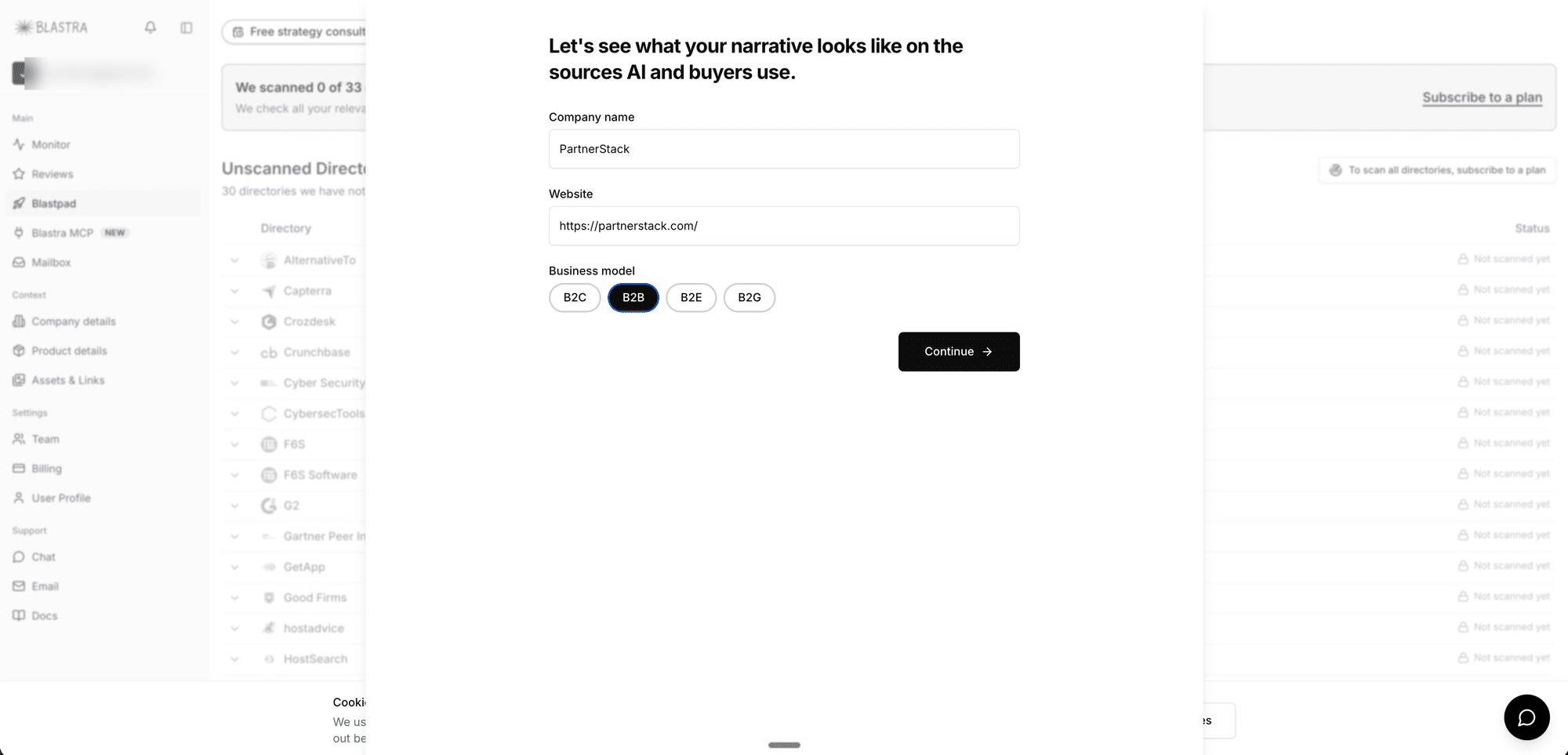
Sign-up takes two clicks. Blastra offers single sign-on with Google, and the first screen asks a few questions about your company, your website and your business model (B2C, B2B, B2E or B2G). From there, Blastra took less than five minutes to analyze
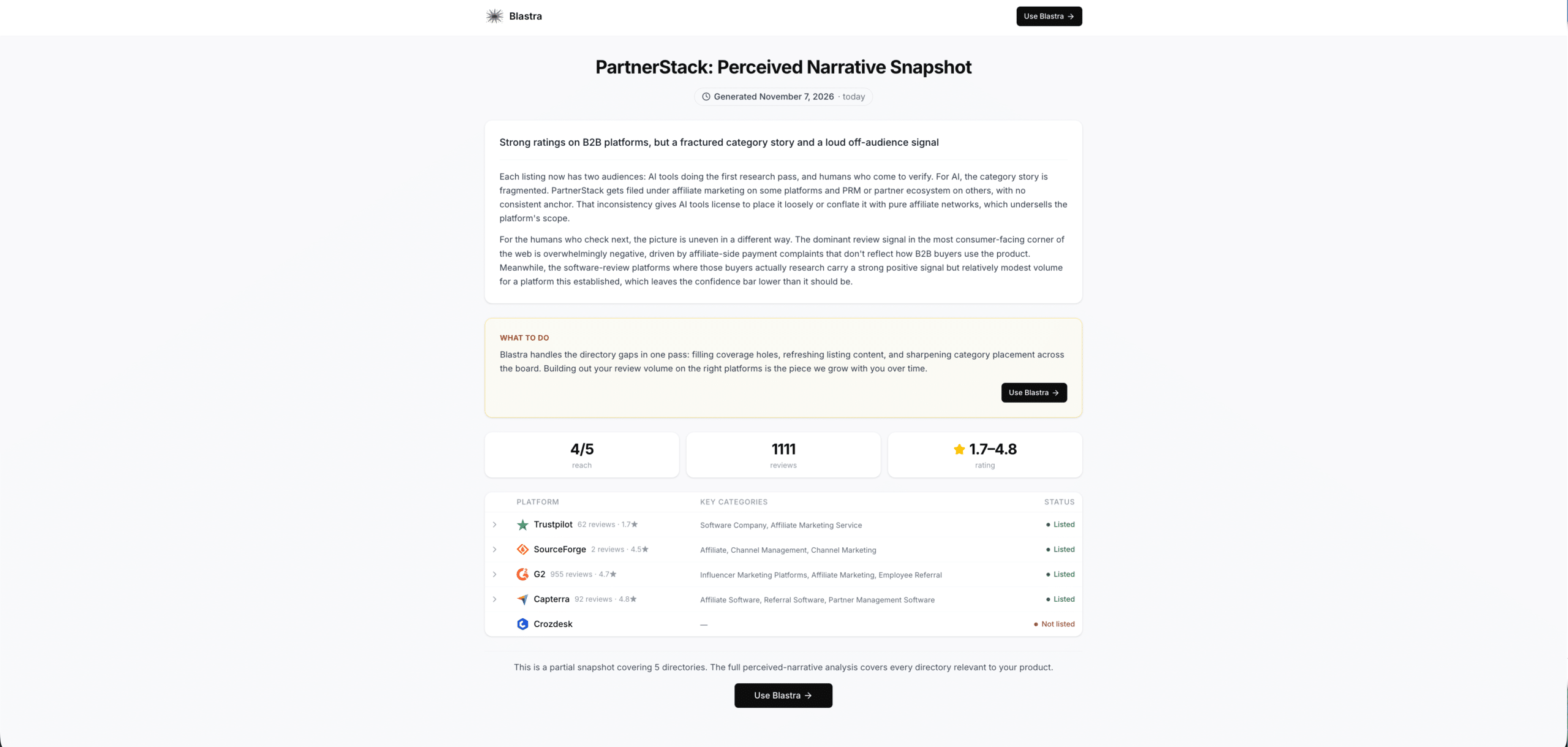
The output is a Perceived Narrative Snapshot: how your company comes across to AI, based on your
Two more things stood out during onboarding:
- The chat reaches the founder. The free account’s support chat gives you access to Katya Rozenoer, Blastra’s founder.
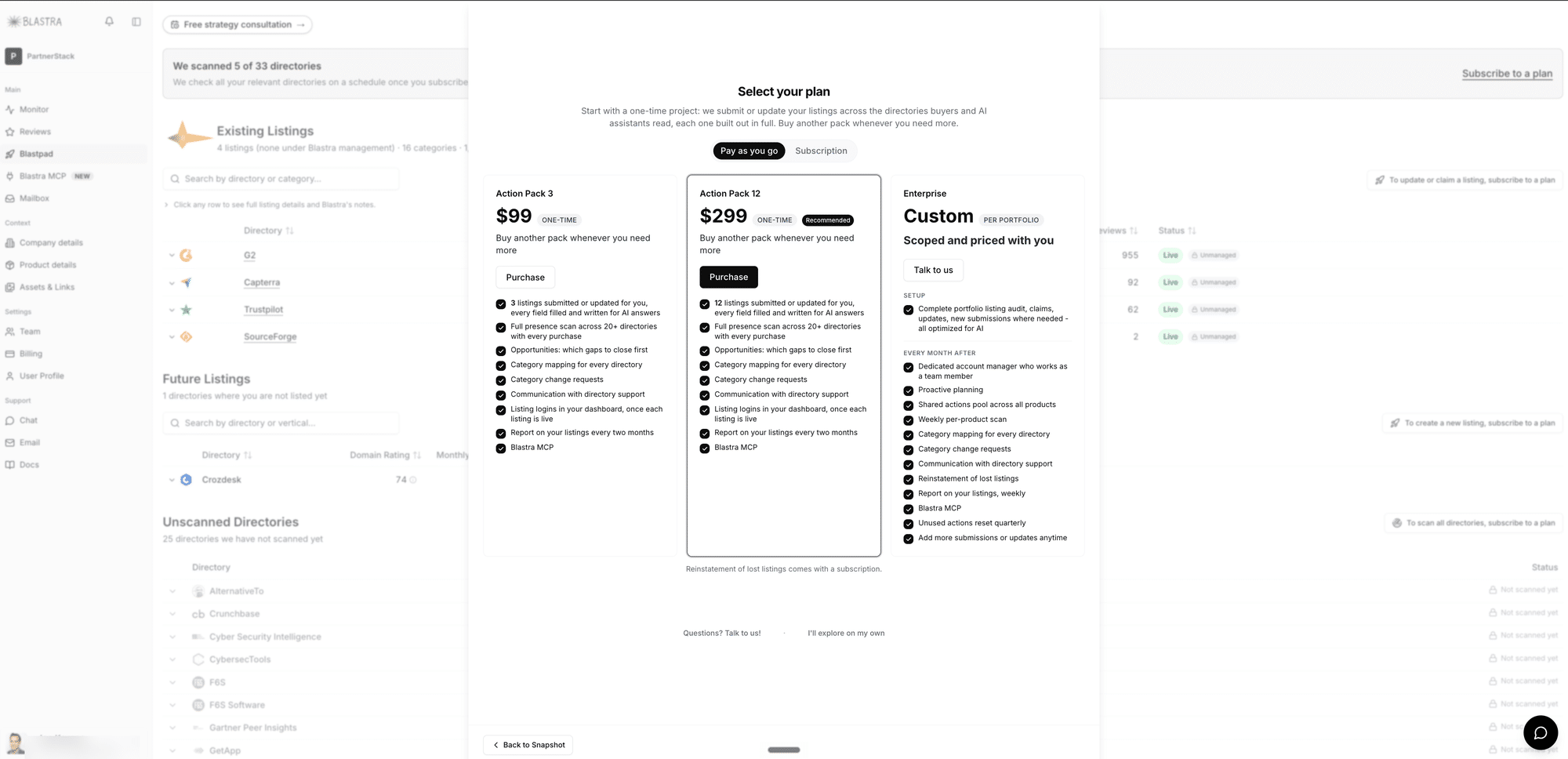
- The way out of the pricing pop-up is easy to miss. After the snapshot, Blastra shows a pricing pop-up. If you don’t pick a plan, there’s no clear way to keep exploring, and no clear way to log out and try a different brand. After some clicking around, I found a small “I’ll explore on my own” link at the bottom of the pop-up. It takes you past the snapshot to the dashboard. If you’re evaluating Blastra, look for that link.
What does Blastra’s Perceived Narrative Snapshot get right?
For a five-minute, automated read, it got a lot right.
- It understood
PartnerStack ‘s two-sided market. It picked up both audiences: the partners inPartnerStack ‘s network (PartnerStack advertises 135,000+ active partners) and the several hundred partner teams at B2B SaaS companies that run their programs on it. - It pulled
reviews from across the web to show howPartnerStack is described, not just where it’s listed. - It mapped
PartnerStack ‘s key categories on each directory and found a directory it isn’t on (Crozdesk). - It shortlisted the right kind of directories. Past the snapshot, the scan covered 5 of the 33 directories on Blastra’s list. Based on what I know about B2B SaaS review sites, it earns high marks for picking a relevant shortlist.
The pitch makes sense to me. In my experience across several early-stage SaaS companies, Series B and earlier, there’s often no customer marketer or anyone else managing review sites on an ongoing basis. Filling directory gaps, refreshing listing content and sharpening category placement fall to the back burner, and often don’t get done for long stretches. A low-cost way to close those gaps in one pass solves a real problem.
Where does the snapshot fall short?
It’s very good, but it isn’t finished. These are the gaps I found on
It doesn’t rank directories by importance
The snapshot lists recommended platforms, but not in order of importance. That’s what a marketer needs to decide where to spend time. For
- G2, because it’s where most
reviews for companies in this category live (and more importantly, where rank highly in Google and LLM buyer searches. - Gartner Peer Insights, because many enterprise buyers go there for
reviews , and it’s rising in importance for B2B SaaS companies because Gartner’s leading domain authority helps it win more and more in Google and LLM search results. - Capterra, GetApp and Software Advice together, because all three rank highly in Google search (and share one set of
reviews ).
It names the problem but not the fix
The snapshot says
What would it recommend? Leaving G2’s affiliate marketing category, for example? That’s a real positioning trade-off.
It can’t tell a busy directory from a useful one
Blastra’s first recommended action for
To be fair, if the goal is more AI trust signals, more
Some directories don’t belong, and some are missing
The scan list included “Open a Nursery UK”, a directory of suppliers to UK childcare nurseries. That’s irrelevant to a partnerships platform.
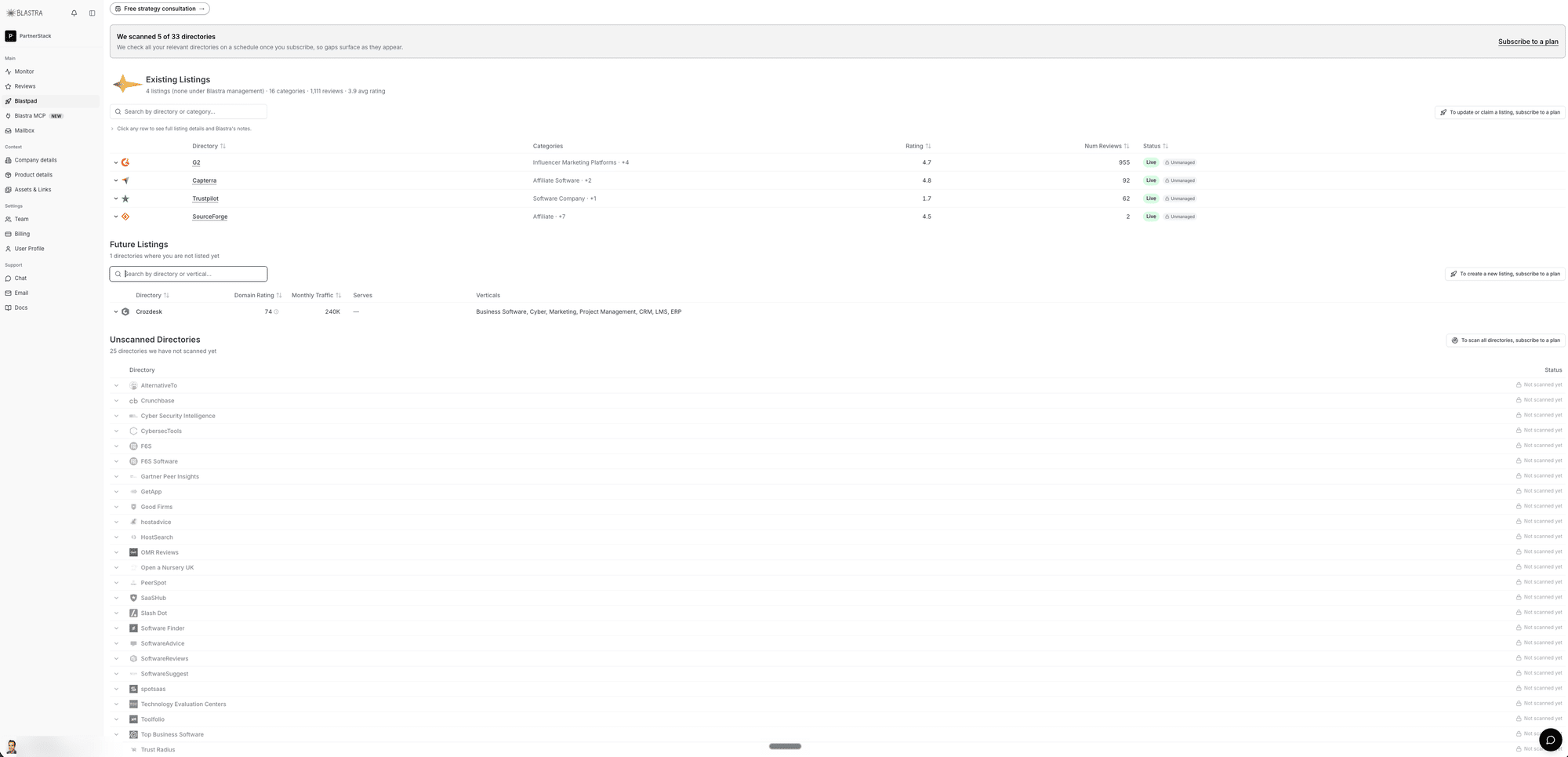
It also doesn’t track app marketplaces with
A partial scan can look like a gap
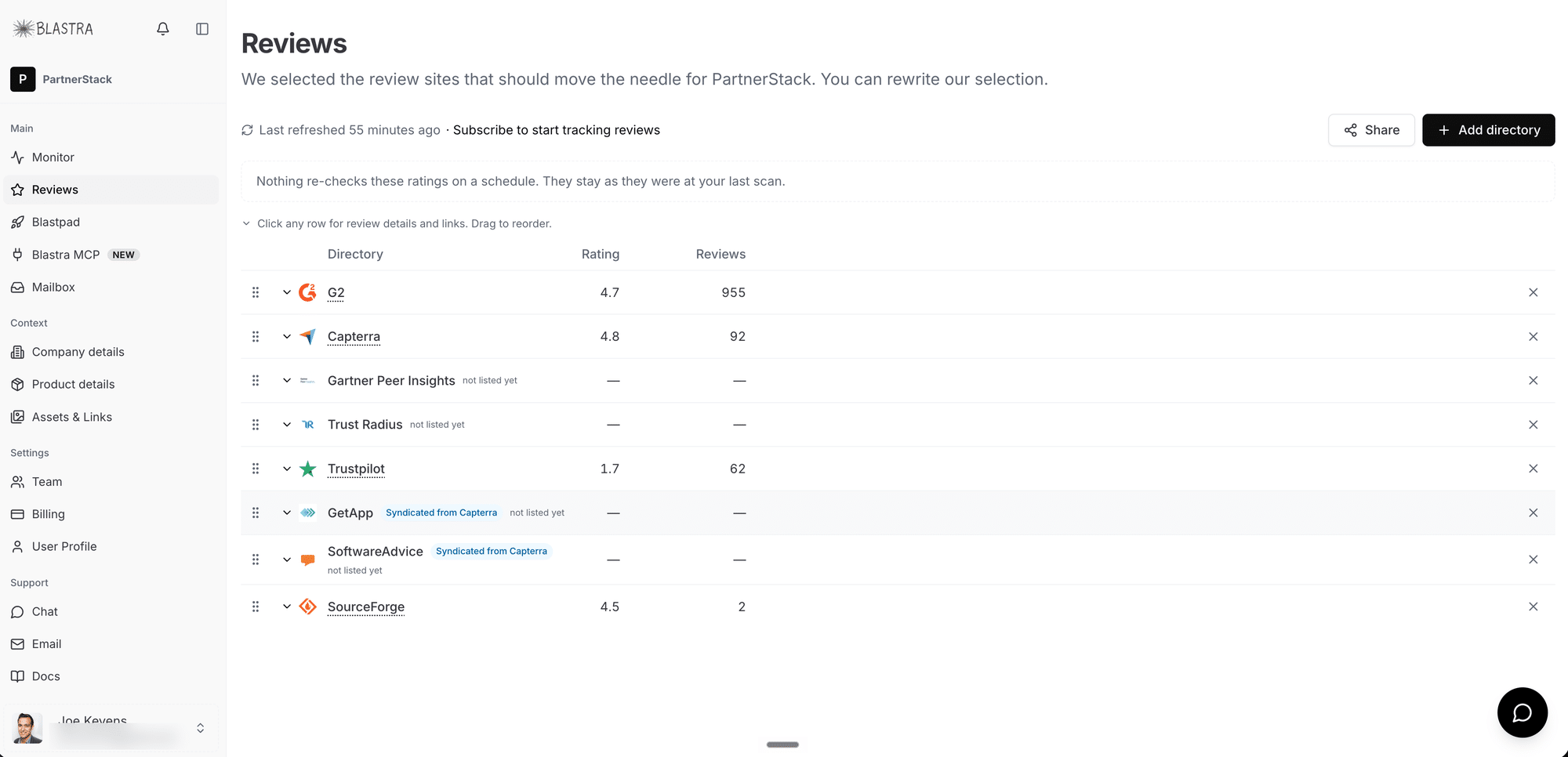
The free account doesn’t run the full scan, so directories outside the first five can show up as “not listed” even when you are listed. Blastra showed
What is the Blastra star, and can you trust it?
Blastra’s Monitor includes the Blastra star, a diagram of your presence across the directories it scanned. Each ray is one directory where you’re listed. A ray grows longer as that listing gathers
PartnerStack’s star had four rays: Blastra scanned five directories and found
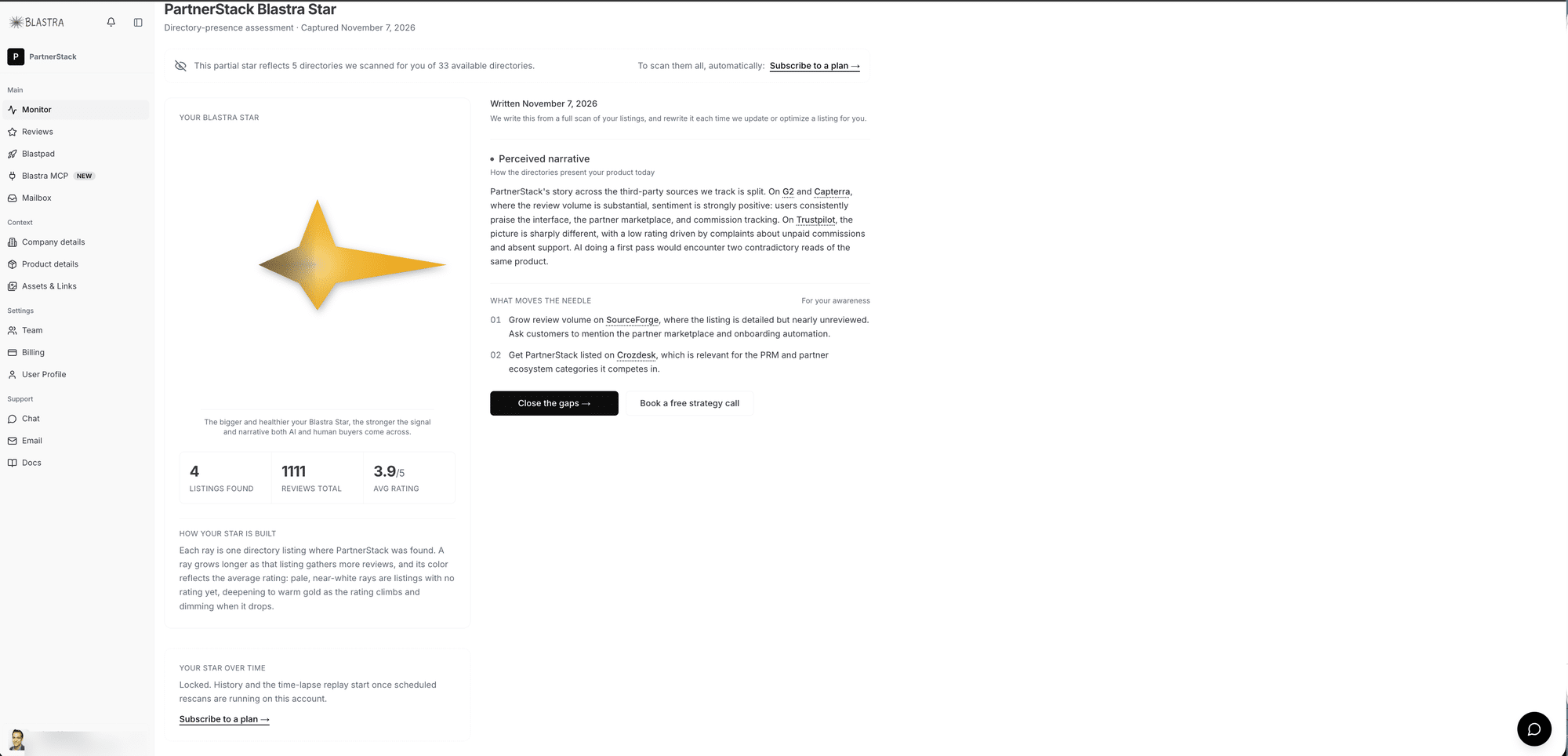
It’s a handy visual for colleagues who don’t live in review sites. Read its header numbers with care, though. The star summed
The snapshot gives the context the star lacks. Its headline called out “a loud off-audience signal” and traced the Trustpilot complaints to the affiliate side, which it said “don’t reflect how B2B buyers use the product.” Here’s the story behind that signal.
Why PartnerStack ‘s Trustpilot rating is 1.7
PartnerStack’s Trustpilot rating is low because it was “review-bombed”. One of the B2B SaaS companies running a partner program on
In retaliation, the expelled partners formed a Facebook group, and one of them posted that they should each leave 1-star
Then the escalation slipped through the cracks.
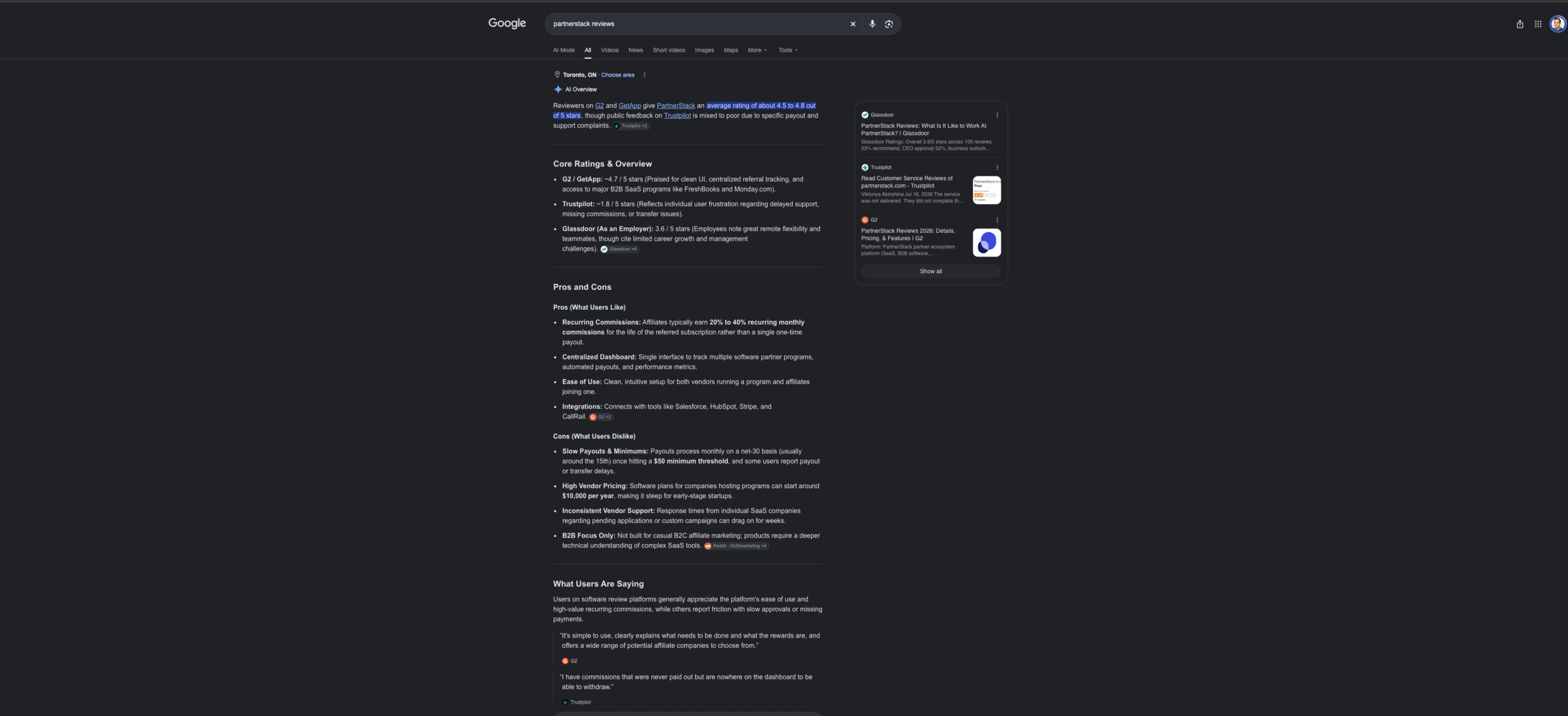
The rating still shows up in AI answers. Google’s AI Overview for “partnerstack
What does the Blastra MCP add?
The Blastra MCP connects your Blastra account to Claude, so you can ask questions about your directory presence. I think it could be one of Blastra’s most powerful features, and it’s included with the free account.
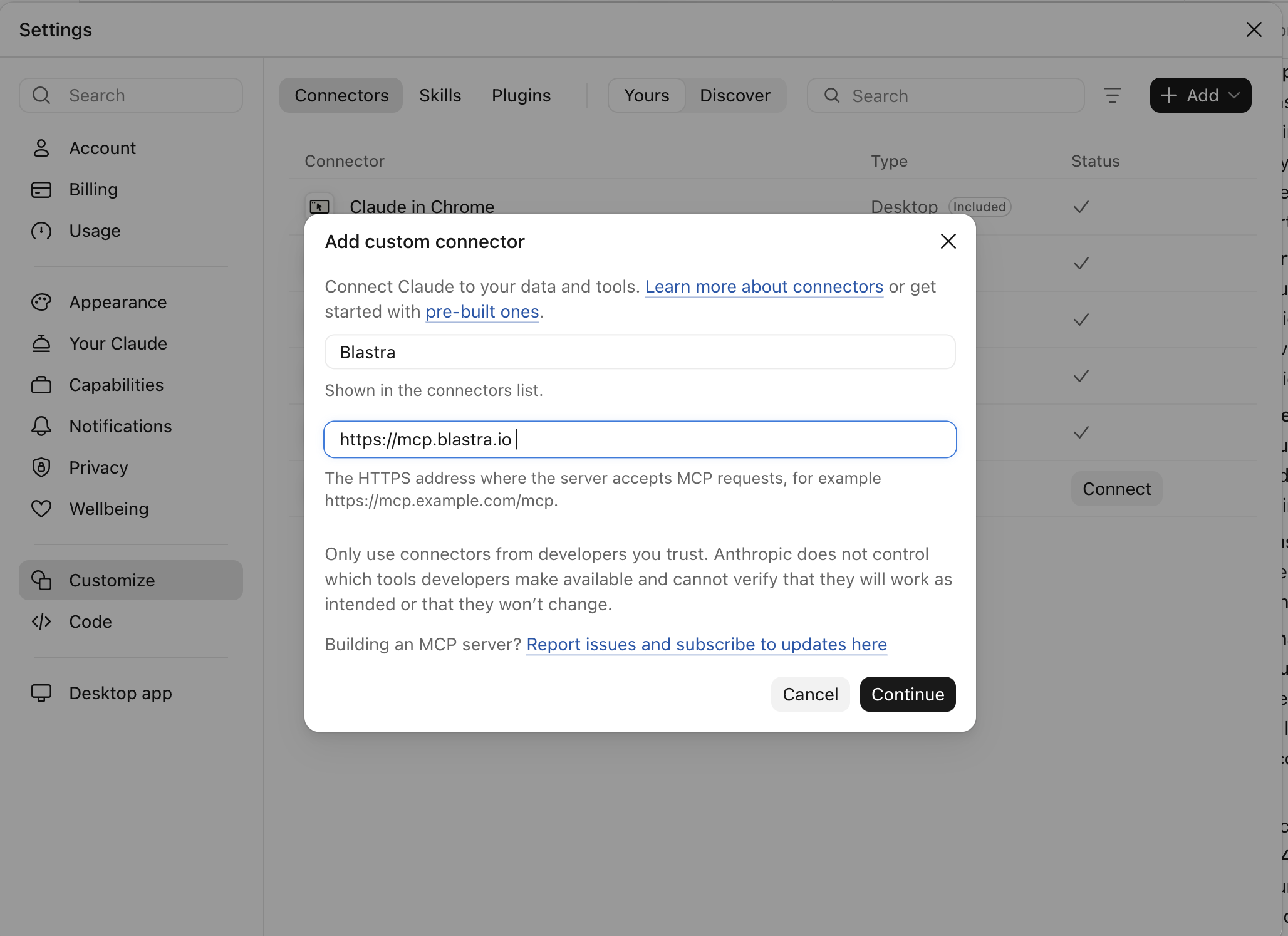
Setup was easy, with clear instructions from Blastra. It took me a few minutes, and I’m still relatively new to Claude connectors. Inside Blastra, there’s a clear table of what the MCP can access and a list of prompts to try. In Claude, you add it as a custom connector (Settings, then Connectors, then Add custom connector) with the address https://mcp.blastra.io.
Know its limits. Most of its tools are read-only: it can’t start a scan, submit or claim a listing, or buy anything. Blastra also says accounts with multi-factor authentication can’t connect yet.
I tried two of Blastra’s suggested prompts and one of my own.
“Where am I missing, and what should I fix first?” I asked one of Blastra’s suggested prompts: “Which directories are we missing from, and which of those would you prioritize first?” Claude correctly noted that Blastra had checked only 5 of its directories on the free account. It then ran web searches to see which of the bigger ones already list
- Crozdesk got a second vote. Claude confirmed Blastra’s recommendation to get
PartnerStack listed on Crozdesk, so two sources now agree. - It suggested SoftwareReviews. Claude recommended SoftwareReviews, Info-Tech Research Group’s review platform (domain rating 73 in Blastra’s directory data), noting that its reports are used for enterprise shortlisting. From what I know of SoftwareReviews, it’s also helpful with government buyers, so it’s worth a look if you sell to the public sector.
- It named a risk instead of more listings. Claude said fixing the listings
PartnerStack already has would do more than adding new ones. It pointed to the 1.7 Trustpilot rating, and to Blastra’s own finding that AI answers about a vendor’s billing and support mostly cite Trustpilot. That seems like sound advice to me.
“Which free directories accept B2B products and don’t list us yet?” I asked another of Blastra’s suggested prompts: “List every directory where we are absent but that accepts B2B products and is free to list on.” Claude found 8 and gave each one a domain rating and a fit rating for
The answer also explained what it left off: directories where it found a
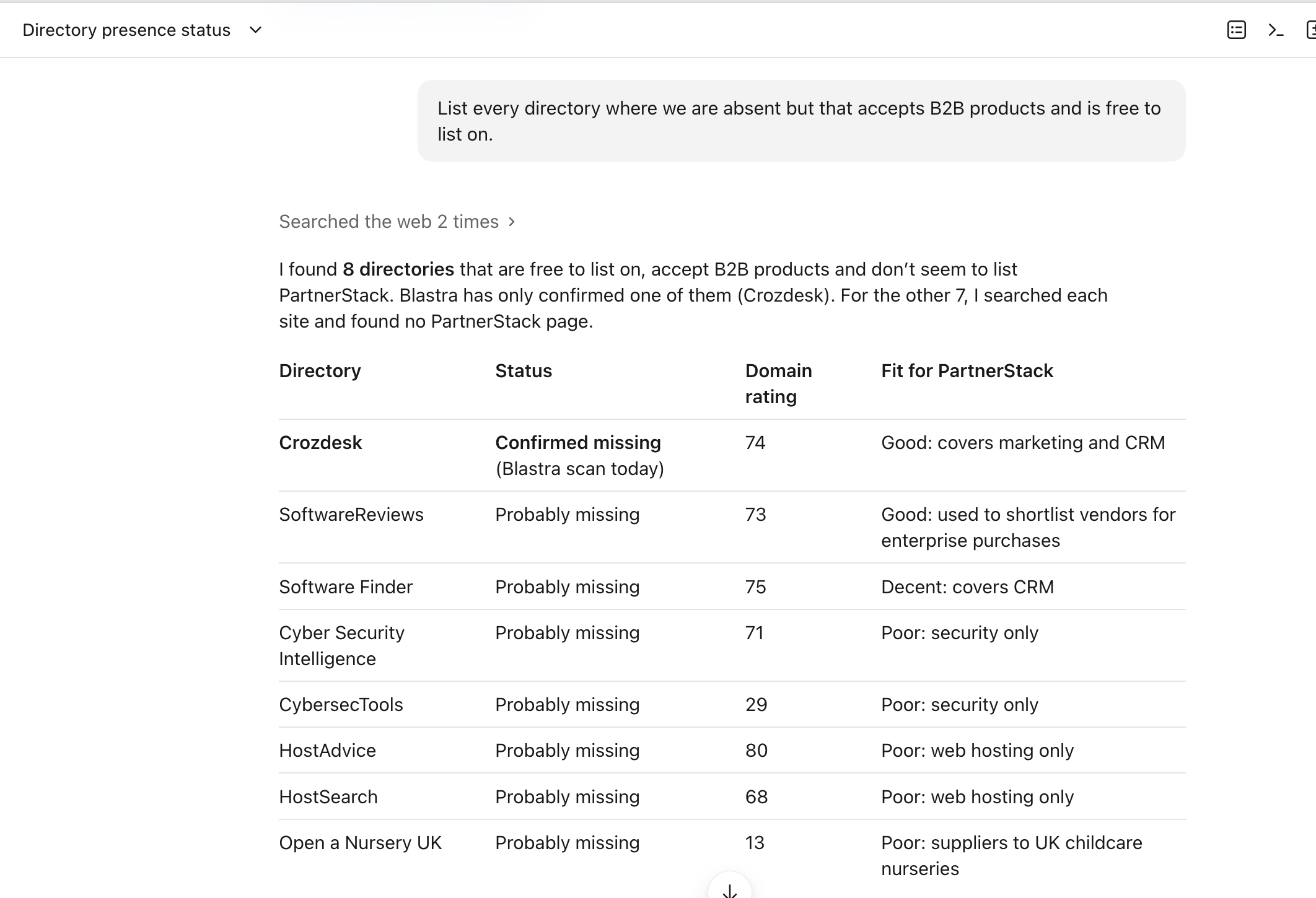
I also asked about app marketplaces, the gap I flagged earlier. Nothing new came up worth pursuing:
That’s the real value of the MCP: Claude can check beyond the directories Blastra has scanned and tell you which gaps are worth closing.
What would Blastra have taken off my plate at PartnerStack ?
If I’d had Blastra when I was running G2 and the other review sites at
| Blastra would have handled | Still my job |
|---|---|
| Updating product details and key features in one place, instead of site by site (when Blastra republishes a listing, it uses an action from another pack or a subscription’s monthly allowance) | Generating the actual |
| Finding more directories to list on, like Crozdesk, for SEO and AI visibility | Building the user lists to ask |
| Access to a review-site expert on a strategy call, instead of working the strategy out myself through lots of research | Creating the email and in-app review flows |
| Pulling together how buyers and AI see us across the top directories, in one five-minute read, instead of checking each site’s | Managing incentive budgets |
That first row adds up fast.
Blastra offers a free strategy call, and I’d take it. I’ve spoken with Katya, and she knows the review landscape and review management at an expert level. A 30-minute call with her is a valuable free offer.
What about Blastra writing and submitting listing copy without showing it to you first? Some teams won’t be comfortable with that. At
How much does Blastra cost, and is it worth it?
Prices from Blastra’s pricing page, as of November 7, 2026:
| Plan | Price | What you get |
|---|---|---|
| Action Pack 3 | $99 one-time | 3 listings submitted or updated, plus a full presence scan |
| Action Pack 12 | $299 one-time | 12 listings submitted or updated, plus a full presence scan |
| Pulse | $99 setup, then $59/month (first month included) | 3 listings at setup, 1 more a month, monthly scans |
| Minimum Viable Presence | $299 setup, then $99/month (first month included) | 12 listings at setup, 3 more a month, weekly scans |
| Enterprise | Custom | Full portfolio audit and weekly per-product scans |
The Blastra MCP is listed on every plan.
The packs and the subscriptions do different jobs. A pack is one round of work: 3 or 12 listings created or updated, once. If your product details change later, you can update the listings yourself with the logins Blastra leaves in your dashboard, or have Blastra republish them, which uses more actions (another pack). A subscription is for upkeep: after setup, Pulse submits or updates 1 listing a month and Minimum Viable Presence 3, with regular rescans. Reinstating a lost listing also needs a subscription.
Who should buy it and who should do it themselves comes down to two questions: how many review sites you’ll list on, and how much time you have to spend on them.
In general, I think it’s worth it. Start by seeing the done-for-you submissions in action with the $99 pack (3 listings plus a full presence scan). Then consider a larger package for ongoing support, depending on how much time you have and how much you value consistent, structured listings across multiple review sites, kept up to date with minimal effort.
Think about the opportunity cost: what an hour of your time is worth, and how many hours it takes to create and maintain listings across these sites. For most SaaS professionals, there’s a lot of value at these prices, and the $299 pack for 12 listings is still reasonably priced.
What I couldn’t test
To recommend Blastra more fully, I’d need to pay for a plan, list a B2B SaaS product on multiple sites through it, and manage those listings for a few weeks. Directory approvals alone take anywhere from instant to more than two weeks, depending on the site. So this review covers the free account and the MCP, not the done-for-you service itself. I’ll update it if I run that test.
Blastra FAQ
Is Blastra legit?
Yes. It’s a real company with a working product, and its free account produced an accurate read of
Does Blastra have a free trial? Its pricing page doesn’t advertise one, but you can sign up for free. The free account includes the Perceived Narrative Snapshot, a 5-directory scan, the dashboard and the Blastra MCP. The paid listing work starts at $99.
How much does Blastra cost? Paid plans start at $99 one-time for 3 listings. Ongoing plans are $99 setup plus $59/month, or $299 setup plus $99/month, and Enterprise is custom (as of November 2026).
Does Blastra work with Claude? Yes. The Blastra MCP connects your account to Claude, so you can ask about your directory gaps, priorities and free listing options. Setup took me a few minutes.
Is Blastra better than doing it yourself? It depends on how many sites you’ll list on and how much time you have. The $99 pack is an inexpensive way to see the done-for-you service in action before you commit to ongoing support.
Blastra won’t get you
Try it: Blastra
Related reading: 10 Best Software Review Sites · Why software reviews matter in B2B · Reviewflowz for monitoring the